About the Journal
Didaktik Slawischer Sprachen (Didactics of Slavic Languages) (DiSlaw) is an Open Access journal that is published twice a year and follows a strict double-blind peer review process. DiSlaw is indexed by the DOAJ (Directory of Open Access Journals), Erih+, MLA International Bibliography (Modern Language Association) and listed in the Fachportal Pädagogik (Education Research Portal) and Ulrichsweb.
DiSlaw meets the urgent need for a subject-specific journal focused on the teaching and learning of Slavic foreign and heritage languages in German- and English-speaking regions. It combines theoretical foundations with practical approaches to address the challenges of guided language acquisition.
We – the editorial team – do not see subject didactics as a mere collection of best practice examples but rather as a research-driven, theory-based, and practice-oriented discipline. Therefore, DiSlaw provides a publication platform for various types of contributions that engage with the teaching and learning of Slavic languages. In addition to scientific-theoretical articles and theory-guided studies from teaching practice, DiSlaw also publishes practical teaching examples and book reviews (e.g., of textbooks).
DiSlaw presents itself as a multilingual journal, publishing articles in German and English as well as in Bosnian, Croatian, Russian, Serbian, Slovenian, and Ukrainian. The journal is also open to contributions in other Slavic languages.
Current Issue
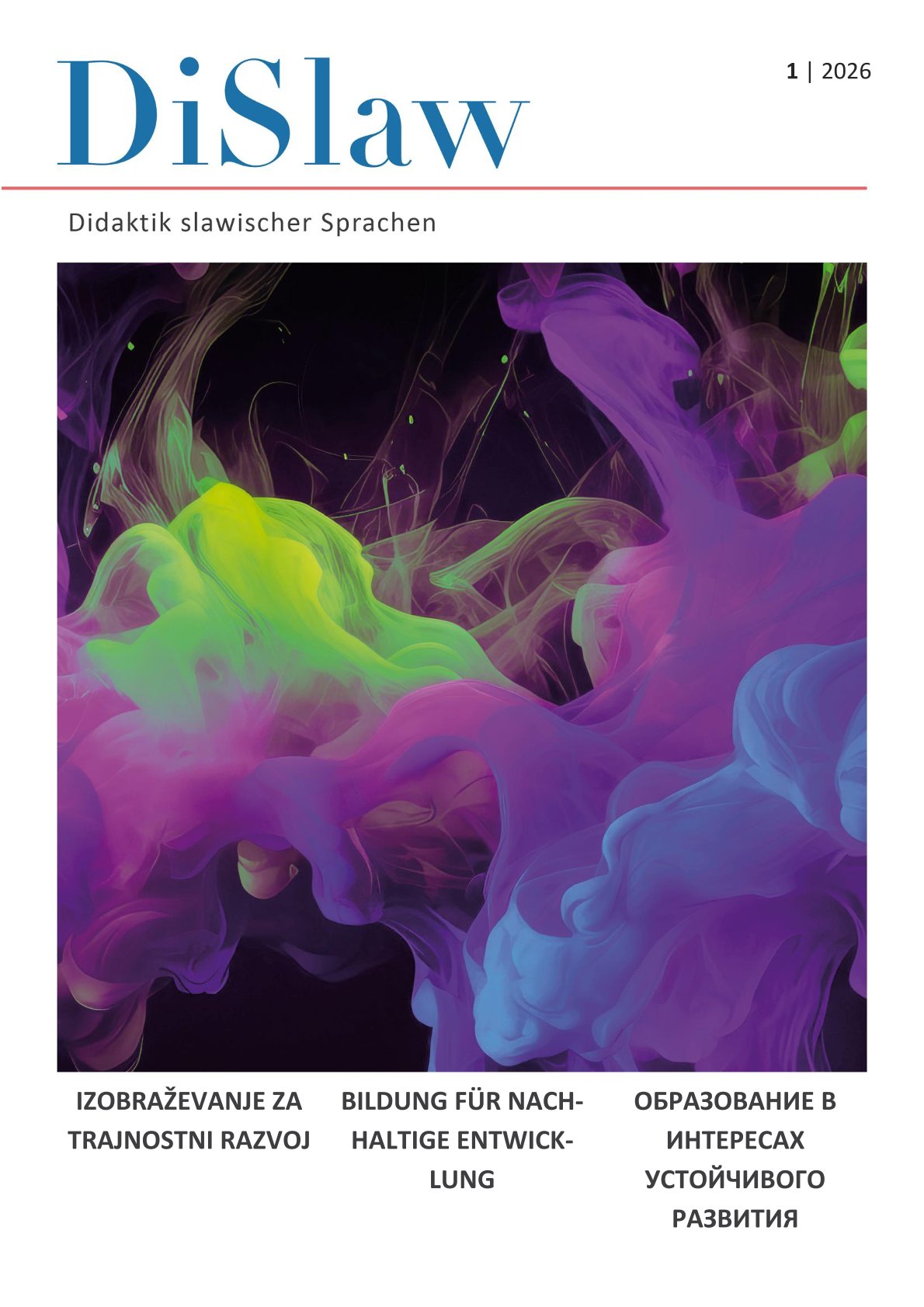
How can education for sustainable development (ESD) succeed in Slavic language teaching, and how can one thus contribute to creating a more sustainable world? Critical-ecological awareness-raising is a task and a goal of both ESD and Global Citizenship Education (GCE), i.e. of educational concepts recommended to be implemented as a cross-disciplinary matter throughout all subjects and classes by the UNESCO roadmap #esdfor2030. In foreign language teaching, the issue of sustainability can be raised in various ways in the context of interacting with language, culture and literature – the three pillars of foreign-language teaching. A framework is available in the form of the 17 UN Sustainable Development Goals (SDGs), codified since 2015 in the Agenda 2030 "Transforming Our World". The tenth issue of DiSlaw is dedicated to the possibilities of ESD in the interest of cultural sustainability in Slavic language teaching.