About the Journal
Didaktik Slawischer Sprachen (Didactics of Slavic Languages) (DiSlaw) is an Open Access journal that is published twice a year and follows a strict double-blind peer review process. DiSlaw is indexed by the DOAJ (Directory of Open Access Journals), Erih+, MLA International Bibliography (Modern Language Association) and listed in the Fachportal Pädagogik (Education Research Portal) and Ulrichsweb.
DiSlaw meets the urgent need for a subject-specific journal focused on the teaching and learning of Slavic foreign and heritage languages in German- and English-speaking regions. It combines theoretical foundations with practical approaches to address the challenges of guided language acquisition.
We – the editorial team – do not see subject didactics as a mere collection of best practice examples but rather as a research-driven, theory-based, and practice-oriented discipline. Therefore, DiSlaw provides a publication platform for various types of contributions that engage with the teaching and learning of Slavic languages. In addition to scientific-theoretical articles and theory-guided studies from teaching practice, DiSlaw also publishes practical teaching examples and book reviews (e.g., of textbooks).
DiSlaw presents itself as a multilingual journal, publishing articles in German and English as well as in Bosnian, Croatian, Russian, Serbian, Slovenian, and Ukrainian. The journal is also open to contributions in other Slavic languages.
Current Issue
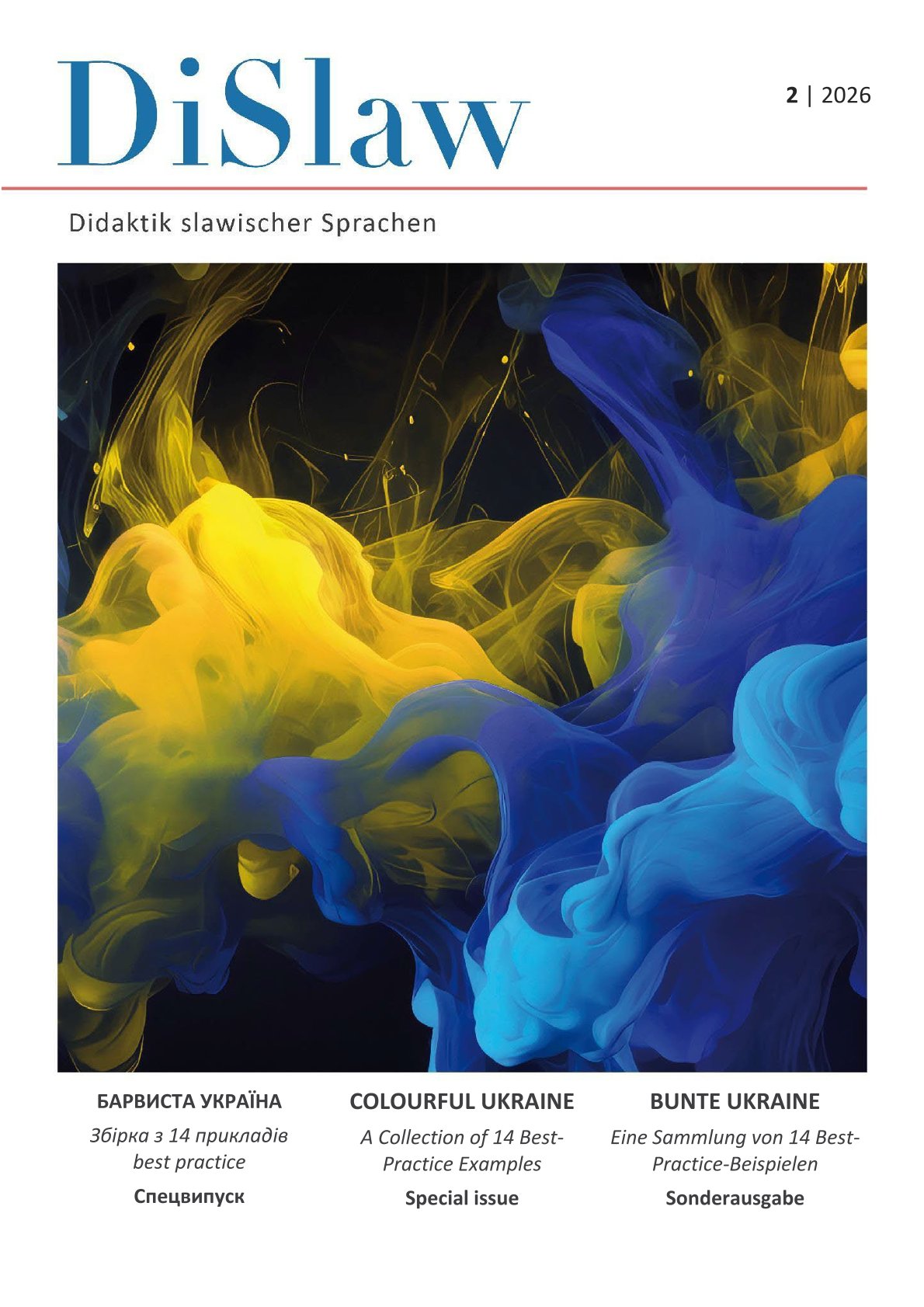
The present best-practice examples are aimed at proficiency levels A1+ to A2+ and follow the action-oriented approach to teaching and learning Ukrainian (CEFR, 2001, 2018). In addition to language acquisition, the examples foster media-based cultural learning and multilingual language learning. The various modes of communication, i.e. oral and written reception, production, interaction, and mediation, are systematically integrated. Vocabulary and grammar are introduced and reinforced through practical application in a range of situational contexts.